| 2026 Atlantic Hurricane Season | | | Arthur | Bertha | Cristobal | Dolly | Edouard | Fay | Gonzalo | Hanna | Isaias | Josephine | Kyle | Leah | Marco | Nana | Omar | Paulette | Rene | Sally | Teddy | Vicky | Wilfred | |
|
|
Active Tropical Systems: Potential Tropical Cyclone One
Atlantic Hurricane Season is from June 1 - November 30
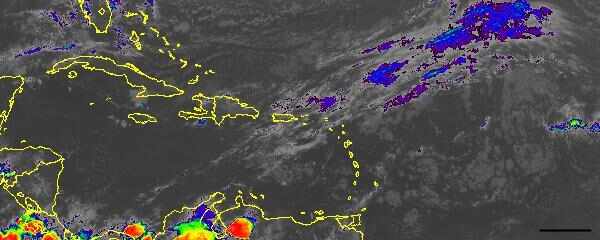
![[GOES-EAST https://weather.msfc.nasa.gov/]](https://img.stormcarib.com/hurrir.jpg)
GOES Satellite - Zoomed in on the Caribbean (03:50 UTC, 14 minutes ago)
Scale bar (lower right) is 250 miles. [more satellite imagery].
See storm-centered satellite image and loop in the tools section below (if available)
Tuesday, June 16, 2026 14:36PM EDT
- PTC 1 (Arthur?)
-
Good afternoon, While this is the Caribbean Hurricane Network, other areas are influenced by our Caribbean weather anomalies. This includes our northern neighbor, the Gulf of Mexico aka the Gulf of America however you choose.
Almost on cue, a home grown system has manifested itself in and along the SW Texas coast,designated 90L, now aka Potential Tropical Cyclone, in a very favorable, moisture laden environment drawing that moisture up from the tropics plus the eastern Pacific. I had shared previously, the Gulf seemed to be ripe for the pickings this year as El Nino picks up in strength putting a welcomed anticipated damper on any Atlantic basin tropical shenanigans as the El Nino antics actually enhance Gulf activity from west to east while having a stifling effect on east to west Atlantic formations.
While overland, TD or TS formation is unlikely, but if the circulation does as expected, it will fall off the Texas coast into favorable Gulf conditions with a short lived chance at reaching TS status before plowing into the Texas Louisiana borderline. Diminishing back to low status before a possible rejuvenation as a TS off the coast of North Carolina or a bit further south. The other course, not out of the realm, is it never leaves its love of the overland and does not fully enter the GOMEX (aka GOA) and not form a closed circulation. Doesn't matter.
Rain, plus some storm surge to the north and east of the front of the system, will be the major effects. While not a drought buster, possible TS Arthur will bring copious amounts of rainfall to the SW and SE coast and inland of Texas, most of Louisiana, Mississippi, Alabama and a dry western Florida Panhandle. Flash flooding is probable with isolated areas picking up over 12 inches. Isolated tornadoes are also a high probability. Down the road, Georgia, NC and SC should see beneficial rainfall as well as it makes its way to the Atlantic where rejuvenation is possible to TS status and even a short lived hurricane as it will be out of El Nino's reach that far north. Even southern Virginia may get a piece of this tropical action.That scenario is 3-4 days away and we all know a lot can happen in that time frame.
Regardless, turn around, don't drown and do not put others in harm's way because you made a bad/reckless decision. Intelligent and informed ones make all the difference.
Stay safe, prepared and ever vigilant.
Dave
Thursday, June 11, 2026 11:27AM PDT - Lower forest and El Nino is here!
- Colorado State came out with their updated June forecast. In April they predicted a slightly below average season, now it is even lower. The expect 11 named storms (14.4 is normal), 5 hurricanes (7.2 is normal) of which 2 might become Category 3 or up (3.2 is normal). The ACE Index (Accumulated Cyclone Energy Index) is only 70, well below the 123 average. The probability of a major hurricane tracking through the whole Caribbean (a large area) is only 25% (47% is normal).
Main reasons for the lower forecast is the 'official' arrival of El Nino as NOAA announced today (see news release). They see a 63% chance of above normal sea surface temperatures in the Pacific 'El Nino' region of 2.0°C (3.6F). This would meet the criteria of a very strong El Nino. Another factor for the lower forecast is that sea surface temperatures in the Atlantic are for a change near or below average, instead of above average.
Below I summarized the probability of at least one major hurricane moving within 50 miles for the Caribbean islands, compared to the long term average (1880-2020). The probabilities are basically half of normal! Full list, incl. US States can be found here. Note that these probabilities are heavily biased by island/region area, for example the Bahamas, being a large region, will have a higher chance of a direct hit.
In spite of the expected slow season and low probabilities we should not take our guard down. Just one storm in your backyard will spoil your whole season. In 2024 Grenada had only a 1% probability of seeing a major hurricane, and then came Beryl... So you still need to prepare, regardless of the forecast. But it is a good feeling that it might be a nice and boring season. -Gert
 | | Probability of a major hurricane traveling within 50 miles |
Monday, June 1, 2026 07:31AM PDT - New season
- We in the Caribbean know what day it is, official start of the 2026 Atlantic Hurricane Season. The forecasts by NOAA, Colorado State and Tropical Storm Risk all point to a below normal hurricane season, with 8-14 tropical storms, of which 3-6 are forecasted to become hurricane, and 1-3 Category 3+ storms for NOAA, 13, 6 and 2, resp., for Colorado State and 11, 4 and 1 for Tropical Storm Risk. The average for 1991-2020 is 14.4, 7.4 and 3.2. Main reasons for the below normal activity are that although ocean temperature is expected to be above normal in the Atlantic, providing more energy for storm development, the upcoming super El Niño should more than cancel that out. El Niño's cause higher vertical wind shear which impedes development and strengthening.
Below the names and pronunciations of this year's players. The list is repeated every 6 years, but new names are introduced if the storm was very deadly or costly. There were 3 names from the record breaking 2020 season with 30 storms (!) retired, Laura, and the Greek letter-storms Eta and Iota. During this covid year, Laura went over the northern islands as a tropical storm and finally made landfall as a Category 4 storm in Lousiana. Back to back storms Eta and Iota both made landfall as a Category 4 along the Miskito Coast in Nicaragua. Covid for sure did not help with the recovery effort in Central America. Eta and Iota are not replaced, since the WMO are not using Greek letters anymore when we run out of names, but a separate list.
Name Pronunciation Name Pronunciation
--------------------------------------------------------------------
Arthur AR-thur Leah LEE-ah
Bertha BUR-thuh Marco MAR-koe
Cristobal krees-TOH-bahl Nana NA-na
Dolly DAH-lee Omar OH-mar
Edouard eh-DWARD Paulette pawl-LET
Fay fay Rene re-NAY
Gonzalo gohn-SAH-loh Sally SAL-ee
Hanna HAN-uh Teddy TEHD-ee
Isaias ees-ah-EE-ahs Vicky VIH-kee
Josephine JOH-seh-feen Wilfred WILL-fred
Kyle KY-ull
Let's hope that it will be indeed a below normal season, but we all know, one big one hitting your island will spoil the whole season for you. Best to start preparations now, check your hurricane shutters if you have, emergency food/battery supplies, etc. You know the drill.
This is year 31 that we are covering the storms for you on the islands! I made the website all ready for the next season, which involves quite a lot of file moves, etc. The big change this year is that thanks to a generous donor from St.John, I decided to get rid of the Google Ads. They were ugly and didn't bring up that much money anyway. The only ad is for Gobeach Vacations, without them this website would never have existed. Donations are still needed of course, you can donate with credit card, PayPal, Venmo and Stripe. Stay safe everybody this season. Don't do stupid things! -Gert
Tuesday, May 26, 2026 09:48AM EDT
- Upcoming 2026 Atlantic season
-
Good morning!
Hope all is well as can be with you.
It's that time of year already for the start of the 2026 Atlantic Hurricane Season. (June 1st). While storms can and have formed before June 1st, this is the official start date.
May 15th meanwhile, is the official start of the Eastern Pacific season which, due to the Super El Nino, is expected to be highly active as well as the Northern Pacific.
That same Super El Nino is expected to contribute to the decline in the number of storms in the Atlantic this coming season. Do not let that contribute to complacency on your part as it only takes one, no matter how many form. Steering currents, along with wind shear appearances will play a major role as will our annual Saharan Dust multi month invasion from the African continent.
Warmer than normal SST's have, at times, negated some of the effects of El Nino's so time will tell how this season will evolve. Regardless, it's time to get your preparations in order, check your remaining supplies and see what is out of date and/or missing and replace. Don't forget your pets as well as they are family too. Test your generator if you have one and plot an evacuation route in the event you have too. Do these things before anything approaches as you will have a lot on your mind if and when the time comes.
The Gulf of Mexico (or America if you wish), unfortunately looks ripe for the picking this season with the much warmer, deeper waters increasing the possibility of rapid intensification close to landfall.
Well that's it for the moment. Let's all pray and keep our fingers crossed again as we do every year.
Stay safe, prepared and vigilant.
Dave
... Older discussions >>
|
| Current Tropical Weather Outlook (NHC/TPC): |
|
|
NWS National Hurricane Center Miami FL
800 PM EDT Tue Jun 16 2026
For the North Atlantic...Caribbean Sea and the Gulf of America:
Active Systems:
The National Hurricane Center is issuing advisories on Potential
Tropical Cyclone One, located over south Texas.
* Formation chance through 48 hours...high...70 percent.
* Formation chance through 7 days...high...70 percent.
&&
Public Advisories on Potential Tropical Cyclone One are issued
under WMO header WTNT31 KNHC and under AWIPS header MIATCPAT1.
Forecast/Advisories on Potential Tropical Cyclone One are issued
under WMO header WTNT21 KNHC and under AWIPS header MIATCMAT1.
$$
Forecaster Adams/Pasch
|
| More detail in the Tropical Weather Discussion or view the Graphicast Image |
|
|
stormCARIB is brought to you by GoBeach Vacations
- Your Accommodation Specialist for the Caribbean - |
|

stormCARIB is hosted
at and supported by
pairNetworks
|
|
 |
Support stormCARIB -- Donations needed --

Latest local updates from the special hurricane correspondents on the islands:
- St.Croix [Jun 16 21:55]
- St.Thomas [Jun 15 7:17]
- Jamaica [Jun 9 8:58]
- Puerto Rico [Jun 6 16:04]
- Nevis [Jun 2 15:50]
- Haiti [Jun 2 15:13]
- St.Maarten/St.Martin [Jun 1 9:04]
- Trinidad & Tobago [May 30 8:10]
- Bermuda [May 22 7:47]
Only reports received for this season are listed. See the archive for previous years.
Links to excellent websites:
- Navy/NRL Monterey
- NOAA/NESDIS (floater loops)
- RAMSDIS Imagery
- Radar Composite - E-Carib.
- Caribbean/Atl. buoy data
- RT model guidance (RAL/NCAR)
- STORM2K forum
- Tracking Waves (McNoldy)
- Radar Loops (McNoldy)
- Tang/UAlbany (model tracks)
- tropicaltidbits.com
- weathernerds.org (ensembles)
- CIMSS/U.Wisc-Mad
- Brammer/UAlbany
- ECMWF Model Forecast
- Jeff Masters Blog
- Brian McNoldy Blog
- Michael Lowry's Blog
- zoom.earth hurricane tracker
- more...
Storm definitions by wind speed:
- Tropical Depression <39mph
- Tropical Storm 39-73mph
- Cat.1 Hurricane 74-95mph
- Cat.2 Hurricane 96-110mph
- Cat.3 Hurricane 111-129mph
- Cat.4 Hurricane 130-156mph
- Cat.5 Hurricane >=157mph
More info in the Practical Guide
Wind force relative to Category 1:
- Tropical Storm 39mph: 0.28x
- Cat.1 Hurricane 74mph: 1x
- Cat.2 Hurricane 96mph: 1.7x
- Cat.3 Hurricane 111mph: 2.3x
- Cat.4 Hurricane 130mph: 3.1x
- Cat.5 Hurricane 157mph: 4.5x
- Irma 185mph: 6.3x
Damage potential relative to Cat 1:
- Tropical Storm 39mph: 0.005x
- Cat.1 Hurricane 74mph: 1x
- Cat.2 Hurricane 96mph: 7.2x
- Cat.3 Hurricane 111mph: 23x
- Cat.4 Hurricane 130mph: 82x
- Cat.5 Hurricane 157mph: 369x
- Irma 185mph: 1372x
|